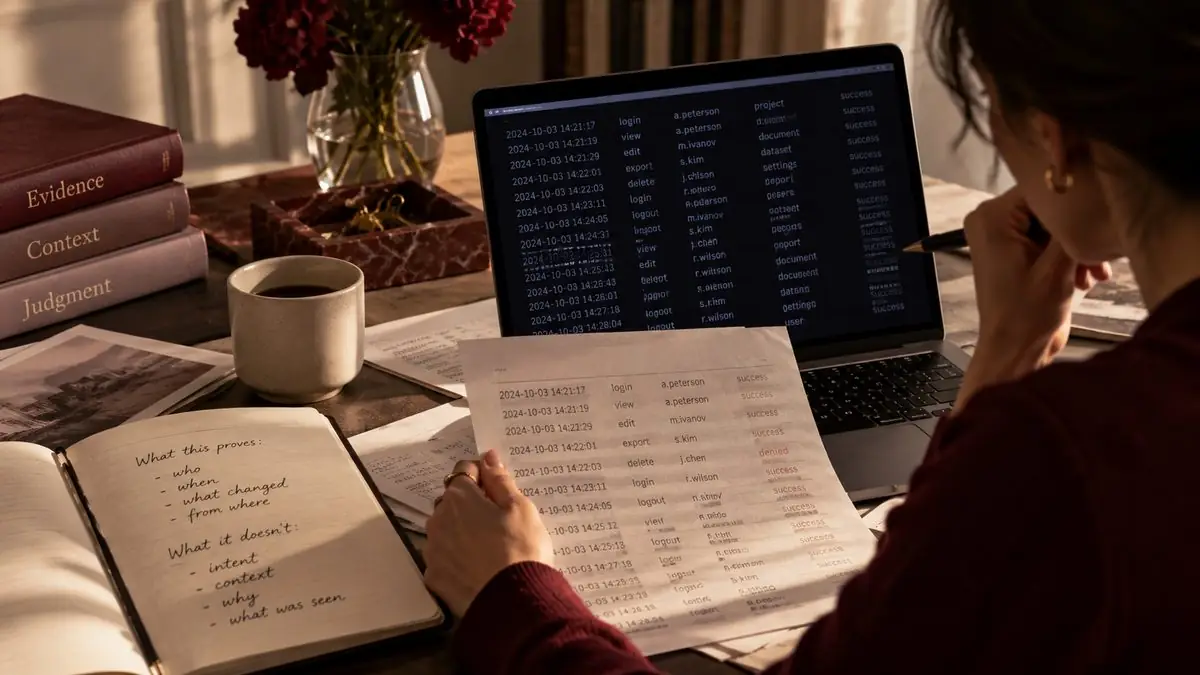


An assistant answers a question about a refund policy and adds a neat footnote to an internal document. A reader clicks it and finds the sentence. Does that settle where the answer came from? It settles one link in the chain. Data provenance in retrieval-augmented generation (RAG) answers covers the rest: which document was retrieved, which version it was, who published it and how the answer was derived from it.
RAG has treated source tracing as a goal since the 2020 paper that named it. Today some model APIs return structured citations that point into the documents supplied with a request. A W3C data model published in 2013, years before the term RAG appeared, offers a useful vocabulary for checking what such a pointer records and what the application still has to keep.
Provenance was named as an open problem
That paper, Retrieval-Augmented Generation for Knowledge-Intensive NLP Tasks by Patrick Lewis and colleagues, stated in its abstract that “providing provenance for their decisions and updating their world knowledge remain open research problems” for large pre-trained language models. The authors described hybrid models with retrieval-based memory as a way to address some of these issues, because accessed knowledge “can be inspected and interpreted.”
That wording is careful. Retrieval makes the evidence available for inspection. It does not, by itself, record the evidence’s history or confirm that the generated sentence uses it faithfully.
A vocabulary for where data came from
The W3C published PROV-DM, the PROV data model, as a Recommendation on April 30, 2013. The PROV overview defines provenance as “information about entities, activities, and people involved in producing a piece of data or thing, which can be used to form assessments about its quality, reliability or trustworthiness.”
PROV-DM gives that idea a small set of terms. An entity is a thing with some fixed aspects, such as a document version. An activity occurs over a period of time and acts upon or with entities, such as an ingestion job or a retrieval step. An agent bears some form of responsibility for an activity. The model then names the relationships: generation (an activity produced an entity), usage (an activity began using an entity), derivation (one entity was transformed or updated into another), attribution (an entity is ascribed to an agent) and quotation (some or all of an entity is repeated).
Mapped onto a RAG pipeline, a single answer touches several of these relationships. A policy document is attributed to the team that published it. An indexing job uses that document and generates chunks. A retrieval step uses some chunks. The answer is derived from them and may quote parts of them. Each relationship is a separate record, and a footnote usually shows only the last one.
What a structured citation records
Anthropic’s citations documentation shows what one API-level citation contains. Plain text and PDF documents are chunked into sentences by default, which sets the minimum granularity of a citation. A citation for a plain text document returns a 0-indexed character range with an exclusive end, a PDF citation returns page numbers, and a custom content document returns content block indices. Each citation also carries a document index pointing to the list of documents in the original request, and the cited text itself.
The documentation states that, because the API parses citations and extracts the cited text directly, “citations are guaranteed to contain valid pointers to the provided documents.” It also reports that in Anthropic’s evaluations the feature was significantly more likely to cite the most relevant quotes than purely prompt-based approaches; that is the company’s own reported result. Two limits are documented as well: the optional title and context fields are passed to the model but are not used as cited content, and PDF scans without extractable text cannot be cited because image citations are not supported.
What the pointer cannot establish
A valid pointer answers a narrow question: does this passage exist, at this location, in a document supplied with this request? In PROV terms it is close to a quotation relationship between the answer and a document. The following points are analysis based on the documentation above, not tests of a particular product.
The pointer does not record how the document entered the request. If the application retrieved an outdated copy of the refund policy, the citation will point accurately into the outdated copy. Version, publisher and retrieval time belong to records the application keeps when it ingests and retrieves documents.
The pointer also does not decide whether the cited sentence supports the claim as written. A sentence about refunds for annual plans can be cited beside an answer about monthly plans. Checking that link still needs evaluation or human review.
| Layer | Question it answers | Where the record usually lives |
|---|---|---|
| Source document | Who published it, and which version? | Document store or ingestion log |
| Indexing | Which chunks were generated from that version? | Indexing pipeline |
| Retrieval | Which chunks were supplied for this question? | Retrieval log for the request |
| Citation | Which passage does the answer point to? | Model API response |
| Support | Does the passage support the claim as stated? | Evaluation or reviewer |
A practical review
Pick one answer from a production system and try to rebuild it. Can the team identify the document version behind each cited passage, the time it was indexed and the query that retrieved it? If the source changed yesterday, would the answer still point to the old text, and would anyone notice? An answer that can be rebuilt this way has provenance. An answer that only has a footnote has a citation.
Access matters too. Provenance records can reveal which internal documents a user’s question touched, so they deserve the same permission review as the documents themselves. Our piece on MCP authorization looks at how an assistant’s access to tools and data is granted, and The AI Research Stack covers the source library such a system depends on.
Reporting & Sources
Lewis et al., Retrieval-Augmented Generation for Knowledge-Intensive NLP Tasks (arXiv 2005.11401); W3C PROV-DM: The PROV Data Model (W3C Recommendation, April 30, 2013); W3C PROV-Overview (Working Group Note, April 30, 2013); Anthropic citations documentation. Sources reviewed October 10, 2026. The pipeline mapping, the table and the review questions are analysis based on those documents.